In 1946, with printing conditions ruined by the defeat, publishing was hard. Even so, there were people who put out books and magazines.
How Yamamoto Mitsuo's *Laws* came to be published
The first edition of Yamamoto Mitsuo's *Plato: Laws, Volume 1* was issued on October 30, 1946.
Yamamoto began translating all twelve books of Plato's *Laws* a month before the Pacific War started. Through an introduction from Itō Nobufumi it ran in the magazine *Nihongaku Kenkyu*, and the serialization continued to the end of Book Two.
When the translation of Book Three was finished, it was decided to publish it. He handed the manuscript to Kondō Shoten at the end of 1944.
The following year, while he was visiting his family, who had been evacuated to a mountain village in Joshu, and enjoying the reunion, a call-up telegram arrived. It was March 8, 1945. He was ordered to report on the tenth, so he threw his preparations together and set off for distant Kyushu amid the villagers' cheers of banzai. Thinking he would never come back alive, he telephoned his old teacher Ide Takashi from a Tokyo street corner and entrusted him with what came after.
In time the galley proofs came from Kondō Shoten, but it was wartime and publication did not follow at once. So part of the galleys and the draft translation of Book Three onward were put in Tanaka Michitarō's keeping. And then it happened. Tanaka was caught in an enemy air raid, suffered severe burns, and the galleys and the manuscript burned up along with his house. The printing plant and Kondō Shoten were struck by the disaster too, and only part of the galleys and a copy of the translator's notes that Mr. Oi of the store had made escaped harm.
And this October, Yamamoto set foot alive on the burnt earth of Tokyo. When he met the proprietor of Kondō Shoten, the man insisted that precisely because these were times like these, the translation of *Laws* had to be sent out into the world. Yamamoto felt the same. Once his wife's illness and his own exhaustion of body and mind had eased, he took up his pen at once, filled in the missing parts, and at last was able to bring it to completion.
Compared with the time when he started the translation, the present feels like another world entirely. But even though the times have changed, Yamamoto's wish has not. He wants every teacher, every lawyer and every politician to read *Laws*. No — the part he has now finished translating, he wants every citizen of Japan to read.
One thing has changed: the purpose of the reading. During the war he kept at the translation in order to deny militarism and to criticize dictatorship in its extreme form. Now he wants it read in order to affirm pacifism and to criticize democracy in its extreme form.
Even setting those wishes aside, *Laws* ought to give its reader instruction, warning and consolation. Listing one by one what is good about *Laws* is a frustrating business. With the finished book in front of him, it is enough now simply to say "take it and read" — that is the sort of thing Yamamoto thinks.
And so a translation spanning several years and more sees the light of day at the moment it is needed. In this Yamamoto felt a joy he told no one about.
But he also thought this. Between the start of the translation and now, things happened in Japan that no one will forget for the rest of their life. Various things happened to Yamamoto too over those long years. The death of his own father, the passing of his father-in-law, the wounding of Tanaka Michitarō, who had helped him so much with the translation, the deaths in battle of young friends, and finally the defeat of his homeland; and himself, who not only failed to die when he should have died for his country but did not receive a single wound. To what should he devote this leftover life he had picked up? Yamamoto knew.
Hayashi Tarō's return
Hayashi Tarō's *New Studies in Physical Science* was issued on May 20, 1946.
Its author, Hayashi, was continuing his research in organic chemistry at Riken while also teaching science at the Women's Higher Normal School. While involved in setting the new-system physical science textbooks, he took on the writing of *New Studies in Physical Science* at the request of Ōbunsha. Just as the manuscript was nearing completion, he was called up.
Part of the manuscript was left in a disordered state, and this was entrusted to Yamamoto Shiro. He was a university classmate of Hayashi's and a close friend, but Yamamoto was not a man of the education world. It was work of a completely different kind, and he could only be bewildered by it. But he was told that a great many boys and girls had this book, and with Ōbunsha's cooperation he pushed the difficult work through and somehow managed to send it out into the world.
Yamamoto hoped it would cultivate the scientific sense of boys and girls and in time bear good fruit for the nation's science and technology. But such is the sadness of the outsider that there were many places where the ordering was not thorough. Yamamoto believed Hayashi would come back. So he left all of it to be corrected after his friend's return.
There were many people waiting for someone to come back from the front. Some came back; some did not.
As for Hayashi — he came back safely.
On May 11, 1947, Hayashi and Yamamoto attended the funeral of their university classmate Fujita Kōkichi, as recorded by Yamaji Kanko, another classmate. So the two of them met again; but what they talked about there is unknown.
(*Ko-senryu* 1(5), Nihon Ko-senryu Gakkai, August 1947. National Diet Library Digital Collections https://dl.ndl.go.jp/pid/1832150)
Hayashi took over Yamamoto's corrections, and in 1950 published the book under a new title, *Studies in Chemistry*, in place of *New Studies in Physical Science*. In 1952 he revised it completely, and he wrote in the preface that the book existed today thanks to the help of Yamamoto Shiro and the support of Ōbunsha.
The sea, the sky and the vegetable patch
*The Sea and the Sky*, published by the Oceanographic and Meteorological Society, came out in a special issue on October 5, 1946.
On March 17, 1945, the great air raid on Kobe engulfed the offices in flames. In the raid that followed on June 5, a third of the offices and the official residences were lost. The society's warehouse and its stock of publications burned, and the Tanaka printing works, which handled the printing of *The Sea and the Sky*, was destroyed.
And three members died in the line of duty.
The stock of publications and all the related documents burned, which caused the members great inconvenience; with effort and good faith from here on, some part of that could be made up for. But the dead do not come back. All that can be done is to think of them and repeat the lament.
The end of the war barely saved this country. But that was all it did. Order collapsed, daily life became extremely difficult, and the Osaka-Kobe region was stripped of its printing capacity. Even so, the people of the society decided to do what had to be done. A journal with a long history had to be published.
They filled the empty posts and worked at restoring the printing plant. To console the spirits of the colleagues who had died in the line of duty as well, they intended to rebuild as far as they possibly could with the backing of the members. And so, after a suspension of a year and more, it has at last resumed publication.
What was completed is a truly meager magazine. Proofreading it, the editor looked out through the cracked window of the offices. Shacks were dotted about the burnt ruins, and a vegetable patch had been made in front of the building. The editorial and advisory committee members, all of them, were out working the fields with plenty of energy outside official hours. The green barley field had turned to ripening barley, and eggplant and tomato flowers were blooming. Looking at this, the editor thought that the recovery of the journal too might come sooner than expected.
Publishing anyway
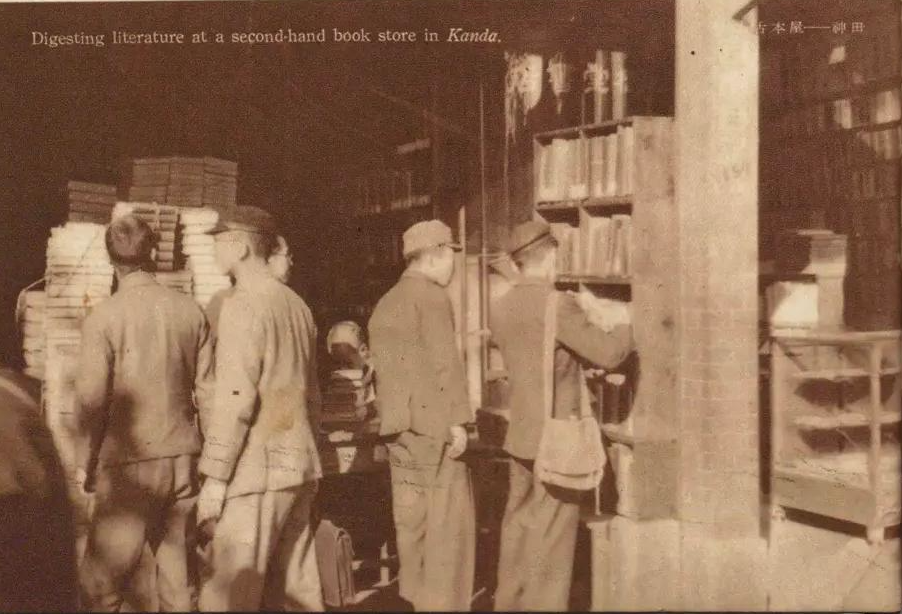
I have heard that after the defeat, books that could not be read openly during the war lined the bookshops and customers came flooding in.
<figure class="figure-image figure-image-fotolife" title="People buying books">[f:id:cocolog-nifty:20260519171111p:plain]<figcaption>People buying books</figcaption></figure>
(Bunkasha, *Tokyo, Autumn 1945* (Tokyo, senkyuhyakuyonjugonen aki), Bunkasha, April 1946. National Diet Library Digital Collections https://dl.ndl.go.jp/pid/1701475)
And there were people making new books and magazines.
Lately we often hear all of you saying, "I want to read books, but they're expensive..." And along with that we see our young friends crowding in front of the shelves in the bookshops, reading while standing. All of you want reading matter the way ants gather on sweet sugar. It was for such good children that this "Wakaba Fairy Tale Collection" was planned, so that we could give you as many bright, enjoyable books as possible, and at a cheap price too.
*Wakaba Fairy Tale Collection* (Wakaba dowashu), Kuwahara Haruka and five others, Shin-Nobeoka Shinbunsha, 1946
It is hard even to imagine now, but there was such a time.

